

What exactly does “secure” mean when you sign a DeFi transaction in your browser wallet? If your mental model stops at private keys and seed phrases, you’re missing the single most practical risk for active DeFi traders and liquidity providers: blind signing of complex, stateful transactions that quietly change approvals or drain balances in ways you didn’t expect. Rabby Wallet reframes the problem by adding a middle layer — transaction simulation and pre-signature risk scanning — and that shift changes both what you should expect from a wallet and how you should operate it.
This piece breaks down how Rabby approaches multi-chain security and usability, what it does well for U.S.-based DeFi power users, where it still has structural limits, and a few pragmatic heuristics you can use when deciding whether to adopt it as your primary browser extension or a dedicated tool in your security kit.
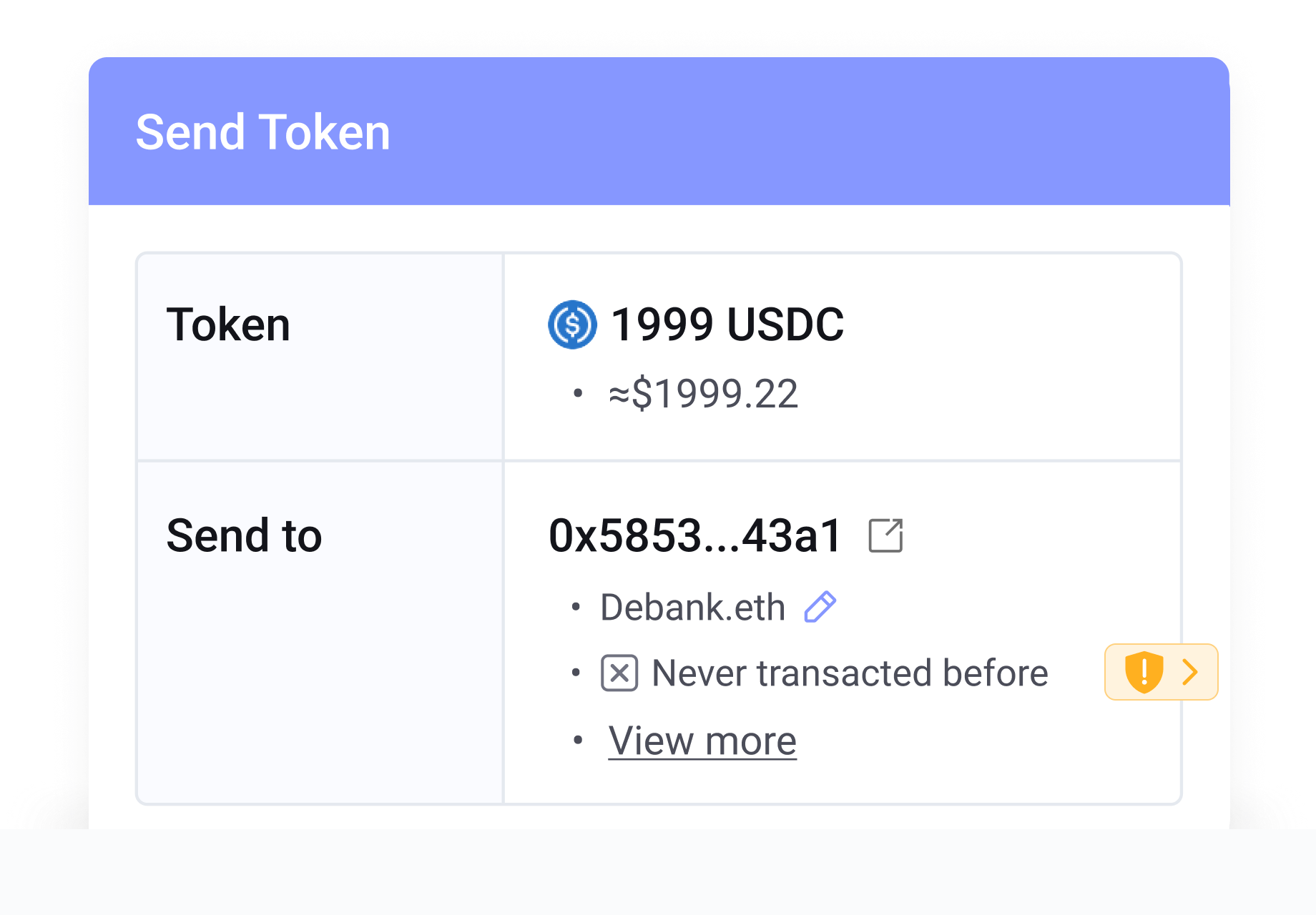
Mechanism first: how Rabby reduces “blind signing” risk
At its core Rabby adds two concrete mechanisms between you and the blockchain: transaction simulation and pre-transaction risk scanning. Transaction simulation runs the proposed transaction locally (or via a safe node) to show the exact estimated token balance changes and the gas/fee cost before you ever sign. Pre-transaction risk scanning overlays heuristics and known-threat checks — for example, flags for previously exploited contracts, suspicious approval requests, or non-existent recipient addresses.
Mechanistically this matters because many DeFi exploits exploit user confusion, not cryptography. A malicious dApp or a compromised smart contract can present an innocuous-looking UI while asking your wallet to sign an approval that permits unlimited token transfers. With simulation you can see the concrete outcome: will your token balance drop? Is an approval being granted? How much native gas will be spent? That turns an abstract consent (“allow”) into a visible state change you can evaluate.
Where Rabby’s combination of features changes real behavior
Several product design choices make Rabby particularly useful for active DeFi users who operate across chains. It supports over 90 EVM-compatible networks (Ethereum, BNB Chain, Arbitrum, Optimism, Polygon, Avalanche, and more), so you can manage cross-chain positions without installing niche add-ons. Automatic network switching eliminates one common operational error: signing on the wrong chain. If you use hardware wallets for cold storage, Rabby’s extensive device support (Ledger, Trezor, Keystone, CoolWallet, GridPlus, BitBox02) lets you keep that safety model while benefiting from the simulation layer.
Institutional or multi-signature workflows are also covered: Rabby integrates with Gnosis Safe and custody vendors like Fireblocks and Amber, so the simulation and revocation tools can sit alongside multi-sig approval flows. For portfolio management, Rabby aggregates tokens, NFTs, and DeFi positions across chains, which matters when you need a single view to decide whether a risky approval is worth the trade-off.
Common myths — corrected
Myth 1: “All browser wallets are equivalent — the risk is only my seed phrase.” Reality: A seed phrase secures custody, but the biggest day-to-day vulnerability for active DeFi users is signing malicious transactions. Rabby’s simulation and approval-revocation tools change that surface.
Myth 2: “Open-source equals safe.” Reality: Open-source is necessary but not sufficient. Rabby being MIT-licensed allows audits and community review, which reduces certain risks, but it doesn’t eliminate smart contract bugs in individual dApps or guarantee perfect runtime behavior. Remember the 2022 Rabby Swap exploit: open-source didn’t prevent the exploit, but the team’s response — freezing the contract, compensating users, and increasing audits — is the governance and operational behavior you should evaluate in a wallet project.
Myth 3: “Automatic network switching is cosmetic.” Reality: For power users who hop across Arbitrum, Optimism, and Polygon, auto-switching reduces human error. But it also creates an attack surface: a malicious site might try to trick your client into switching networks. The simulation layer mitigates the result by showing the concrete transaction outcome even if the network flips.
Trade-offs and limitations you must weigh
No tool is a panacea. Rabby lacks a native fiat on-ramp, so U.S. users will still rely on centralized exchanges or third-party services to purchase ETH or USDC with USD — an important operational step if you want to fund transactions quickly. It also doesn’t offer native in-wallet staking features, which matters if you prefer an all-in-one UX for yield strategies.
Further, simulation depends on accurate node state and correct modeling of on-chain effects. Simulations can miss race conditions or front-running in highly liquid, time-sensitive operations; they report estimated outcomes given current mempool and state, not guaranteed future results. And while approval revocation is a strong mitigation, it requires the user to act promptly and execute revocation transactions (which cost gas).
Finally, the 2022 Rabby Swap incident is an important boundary condition: the wallet team mitigated fallout and improved audits, but the event underscores that even security-focused tools are integrated into a larger ecosystem where third-party smart contracts can fail. Evaluate Rabby not as an absolute blocker of risk but as a strong reducer of common operational mistakes.
Practical heuristics for DeFi power users
Here are three decision-useful rules you can adopt immediately:
- Always read the simulation output before signing: treat the displayed token deltas and fee estimates as the primary “what am I authorizing” statement, not the dApp UI.
- Use hardware wallets for large balances and enable Rabby as an interface: this preserves cold key material while giving you the simulation and revocation layers.
- Maintain a small gas buffer on each chain you use or use the cross-chain gas top-up feature to avoid stalled transactions that expose you to sandwich or expiry risks.
Where Rabby fits in a layered security model
Think of Rabby as a behavioral firewall for signing decisions. In a layered model: custody (hardware wallet or multisig) protects keys; Rabby’s simulations and scans protect signing decisions; centralized controls (KYC exchanges, on-ramps) handle fiat flow. This separation is useful: if one layer fails, the others still provide protection. For example, if a smart contract is malicious, a simulation may reveal unexpected token outflows; if you ignore that and sign anyway, a hardware signer can still stop an automated meter via manual verification. Conversely, if you rely solely on ad hoc browser wallets without simulations, you are implicitly accepting higher operational risk.
What to watch next — conditional scenarios
Two conditional scenarios matter for U.S. DeFi users. First, broader regulatory pressure on fiat on-ramps could push wallets to integrate KYCed pathways; Rabby currently lacks a built-in fiat on-ramp, so watch whether it partners with regulated on‑ramp providers or keeps a permissionless stance. Second, as MEV and mempool-based attacks evolve, the fidelity of transaction simulation will be tested; improvements might include live mempool-aware simulations or integrated relays to reduce front-running risk. If Rabby invests in these directions, its value proposition deepens; if not, external relays and transaction-ordering mitigations will remain necessary complements.
For readers ready to experiment, Rabby is available as a browser extension for Chromium browsers, mobile apps, and desktop clients — and you can import existing seed phrases or flip between Rabby and MetaMask as your default extension. If you want to evaluate it hands-on, start with small-value transactions on a testnet or low-stakes mainnet move, verify the simulation outputs, and exercise the approval-revocation UI so the workflow becomes second nature.
For more details and download options, see the official resource for the rabby wallet.
FAQ
Does Rabby eliminate the need for hardware wallets?
No. Rabby complements hardware wallets by improving the decision layer (what you sign) but does not replace the security benefits of keeping private keys in a hardware device. For large holdings or institutional accounts, combine Rabby’s simulation features with multi-sig or hardware custody.
How reliable are the transaction simulations — can they be wrong?
Simulations show estimated state changes given current chain state and expected execution. They are highly useful for spotting obvious mismatches (unexpected approvals, balance drains) but can miss future race conditions, front-running, or mempool reordering. Treat simulations as a strong heuristic, not an ironclad guarantee.
Is Rabby safe for institutional use?
Rabby integrates with institutional and multi-sig tools (Gnosis Safe, Fireblocks, Amber, Cobo), which makes it suitable as an interface in institutional workflows. However, institutional adoption should still include policy controls, audit trails, and custody procedures beyond the wallet itself.
Can I buy crypto inside Rabby with USD?
Not natively. Rabby currently lacks a built-in fiat on-ramp, so U.S. users will need to use exchanges or third-party on-ramp services to convert USD into crypto before transferring funds into the wallet.
Leave A Comment